Nuclear Power Stations generate electricity, similar to coal oil or natural gas based power stations, by using the heat energy produced from the nuclear reactor. The heat produced in the nuclear reactor converts water into steam, which drives the turbine generator to produce electricity. Unlike coal, oil or natural gas, there is no combustion of Fuel in the nuclear reactor. Heat is produced by the fission (splitting) of atomic nuclei in the reactor.
Operating Nuclear Power Stations
- Tarapur Atomic Power Station Units-1&2 (2x160 MW BWRs),
- Tarapur Atomic Power Station Units-3&4 (2x540 MW PHWRs),
- Rajasthan Atomic Power Station Units 1 to 6 (100 MW, 200 MW and 4x220 MW PHWRs),
- Madras Atomic Power Station Units-1&2 (2x220 MW PHWRs),
- Narora Atomic Power Station Units-1&2 (2x220 MW PHWRs),
- Kakrapar Atomic Station Units-1&2 (2x220 MW PHWRs),
- Kaiga Generating Station Unit-1 to 4 (4x220 MW PHWRs)
- Kudankulam Nuclear Power Station Unit-1&2 (2x1000 MW VVER)
Under Construction Nuclear Power Stations
- Kakrapar Atomic Power Project Unit-3&4 (2x700 MW PHWRs),
- Rajasthan Atomic Power Project Units-7&8 (2x700 MW PHWRs),
- Gorakhpur Haryana Anu Vidhyut Pariyojna Units-1&2 (2x700 MW PHWRs),
- Kudankulam Nuclear Power Project Unit-3&4 (2x1000 MW VVER) and
- Prototype Fast Breeder Reactor (1x 500MW)
A nuclear power plant is much similar to a coal fired thermal power plant except the way heat is produced to raise steam. At the heart of a nuclear power plant, there is reactor core in which the fission reaction in the nuclear fuel, usually uranium, takes place. To be simplistic, in a nuclear fission, a neutron hits the nucleus of an atom of the uranium fuel and splits it, in which two or three neutrons are released and used to cause fission in other uranium atoms. Fission of a single atom of uranium yields energy equal to 200 MeV (million electron volts) in comparison to only 4eV in the oxidation of one carbon atom. Therefore, on equal weight basis the total energy from the nuclear fission of 1 tonne of uranium is about as much as that produced from 2.5 million tonnes of coal combustion. Natural uranium consists of two forms (isotopes) of uranium vis-à-vis U-238, (99.3%) and U-235 (0.7%). It is the less abundant U-235 that leads to fission reactions. U-235 is the only natural isotope that can be made to undergo fission by thermal (slowed) neutrons. However concentration of U-235, as compared to U-238 can be increased by the process called enrichment. An enrichment of about 3 to 4 percent provides considerable flexibility in the design and operation of nuclear reactors although slowing down of neutrons still remains a necessity.
The surplus neutrons produced in the chain reactions are allowed to interact with other atoms to produce even more neutrons. In such a case, the reaction will continue over a time, until fuel is depleted. However, all the atoms available in the reactor core do not undergo fission (other U-235 atoms). Some neutrons escape from reactor core or are absorbed by the surrounding materials. Three scenarios may be envisaged, considering such a neutron economy. First, if more than one neutron is available for reaction, the rate of fission increases with time and the reaction is 'super critical'. Second, exactly one neutron is available for fission reaction such that reaction rate is constant and the reaction is 'critical'. Third, less than one neutron is available for reaction and number of fission decreases with time or the reaction is 'sub critical'. In a nuclear reactor, an increase in the number of neutron is allowed initially to reach the required reactor power and then maintained at that level. The reaction rate is lowered to reduce power level or to shut down the reactor by decreasing the number of available neutrons e.g. by inserting a neutron absorbent like boron or cadmium.
Fission neutrons have high energy and must be slowed down to enhance the chances of inducing further fissions. This slowing down of neutrons is accomplished by a 'moderator', ideally a substance having low neutron absorption. Such reactors which use thermal (slowed down) neutrons by their repeated collision with moderator are called thermal reactors. The Pressurized Heavy Water Reactor (PHWR), mainstay of India's nuclear power programme, is a thermal reactor using natural uranium as fuel and heavy water as moderator and coolant.
Natural Uranium is mined at Jaduguda in the state of Jharkhand and also at Thummalapalli, Andhra Pradesh. It is converted into nuclear fuel assemblies at Nuclear Fuel Complex. A 220 MW PHWR fuel assembly contains about 15 kg of natural uranium dioxide. Uranium dioxide pellets generate heat while undergoing fission and also generates fission products. Fission products are radioactive and should be contained and also not allowed to mix with coolant water. Hence the UO2 pellets are contained in Zirconium alloy tubes with both the ends hermetically sealed.
Unlike other fuels, nuclear fuels 'burn' without any obvious change in the size, shape or appearance of the elements. They do not give rise to bulky ash or harmful fumes. In a nuclear power station such a assembly produces as much electricity as that of 15 wagon loads (i.e., about 380 tonnes) of coal. A 220 MWe reactor unit contains 3,672 fuel assemblies like this. They normally stay in the reactor for about 18 months before being replaced. Careful design and scrupulous quality control measures are taken to guard fuel assemblies against failures in service.
There is no combustion in uranium fuel and a fuel assembly comes out of the reactor in the same way as it went in. However, there is one important difference, when a fuel assembly is removed from the reactor after about 18 months of usage, it contains radioactive by-products as a result of the fission process. Because of this radioactivity, the fuel assembly is handled by remote controlled fuel assembly loading / unloading machine to transfer it for storage in a water-filled pool inside the station. This machinery also feeds new fuel assembly into the reactor. The water cools the used fuel and, along with steel and concrete shielding, protects station workers from radiation. After a period of storage under water, the spent fuel assembly are taken in shielded containers to the reprocessing plant. In Reprocessing plant, operated largely by remote control through heavy shielding, three main product streams are separated.
- Depleted Uranium (about 98%) is stored for recycling in fast breeder reactor.
- Plutonium (about 0.4%) formed when neutrons are absorbed in atoms of non-fissionable uranium. This very valuable and can be used as fuel for fast reactors.
- Mixed long-lived radioactive fission products (about 1%) are vitrified and stored.

Figure 1 Nuclear Fuel Cycle
Nuclear power, like all industries, gives rise to wastes. Because they are in general radioactive, they are subject to strict control. In India, the basic philosophy of radioactive waste management has been to concentrate and contain as much radioactivity as possible and discharge effluents to the environment at as low a concentration level as practicable. Facilities are provided at the nuclear installations for safe disposal of radioactive waste. Solid wastes are stored at site and release of liquid and gaseous effluents are so organised that the prescribed dose limits for public by Atomic Energy Regulatory Board are strictly adhered to. The limits are more stringent than the limits prescribed than International Atomic Energy Agency.
The various waste management schemes adopted are:
- All the gaseous effluents are released to the atmosphere through highly efficient particulate air filters for removal of particulate radioactivity. These are monitored to ensure that releases are within stipulated limits.
- Liquid waste facility provides chemical treatment followed by ion exchange treatment. The wastes are then diluted such that the final concentration of the effluent is below the limits specified by regulatory body.
- Water containing low levels of wastes, after checking, will be sold to capable vendors for recovering by product.
- For low level solid wastes, no direct disposal into the ground is practiced. Wastes are incinerated or baled and stored. Different types of containments are used and located at sites selected on the basis of geological and geo hydrological evolution. This is being followed up by continuous monitoring of ground water, soil and elaborate environmental surveillance through special laboratories set up near installations.
- For long lived, highly radioactive solid wastes generated from at various plants, a three - stage approach has been adopted. Firstly, the waste will be incorporated in suitable and inert solid matrices. The conditioned waste will then be placed in canisters and kept in a retrievable store under cooling and constant surveillance. Ultimately, canisters will be stored in suitable deep geological media. India is one among handful of countries who have mastered the vitrification technology for incorporating high level radioactive waste into glass.
The Chief potential health hazard in a nuclear fuel cycle is the radiation exposure form uranium mining, fuel fabrication, reactor operations, fuel reprocessing and accidents in nuclear facilities.
The Nuclear industry has, from its beginning, given great attention to public health and safety. It carries out operations under different Acts, Regulations and codes of practice etc., based on internationally accepted safety standards. Radiation from radioactivity releases to the environment from normal operation of a nuclear plant is small compared to the natural background radiation from outer space and the material of earth's crust with which man has lived since the creation of the world. It is even less than the additional radiation that we would get from a single chest X-ray.
All reactor units and fuel fabrications plants have elaborate safety systems build into them and are therefore 'fail safe' to ultimate degree possible.
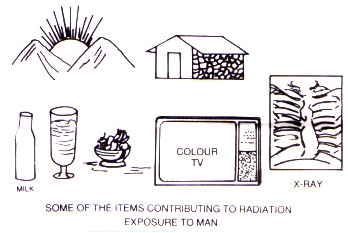
Figure 2 Items Contributing to Radiation Exposure to humans
Every human activity associated with some risk. Risk is defined at the probability of occurrence of an undesirable effect as a result of an action or lack of it. We are subjected to a small risk all the time whatever we do-even if we stay at home. On an individual basis each person has learnt to accept an element of risk involved in travelling, smoking, drinking, eating etc. The following activities involve a risk of one death in a million.
- 650 kms air travel
- 100 kms car travel
- ¾ of cigarette smoking
- 1.5 mts of mountain climbing
- 20 minutes of life at age 60
- Use of oral contraceptive pills for 2 1/2 weeks
- Half a bottle of wine, or Exposure to 0.1 mSV of ionizing radiation, which is approximately equal to the exposure received during a chest X-ray.